Orthodontic Consent Forms: What Every Practice Should Cover
The risks, agreements and signatures an orthodontic consent form should cover for braces and clear aligners, plus how to walk a family through it without rushing.
By ChairsideKits Team · · 7 min read
Eighteen months into treatment, a parent calls about white marks on their son's front teeth. They remember the start appointment as "we signed some papers." Your treatment coordinator remembers explaining decalcification in detail. The chart has a single signature on a one-page form that lists eleven risks in small print, with no initials and no note of what was discussed.
That conversation goes better when the orthodontic consent form did its job at the start. This article covers what a good orthodontic informed consent should include, the separate agreements that belong next to it (clear aligners, retainers, finances, photos), and how to present the whole packet so patients and parents actually read it.
What an orthodontic consent form should cover
A complete orthodontic consent form generally has these parts:
- The proposed treatment in plain words: braces, clear aligners, an expander, and roughly how long.
- The known risks and limitations, each as its own short clause the patient initials.
- Alternatives, including no treatment, and what each would mean.
- Patient responsibilities: hygiene, wear time, elastics, keeping appointments.
- Space for patient-specific risks and questions the patient asked.
- Signatures and dates from the patient, a parent or guardian for minors, and the orthodontist.
The first five are what make consent "informed." The last one only records that it happened.
The risks to list, one clause each
Most orthodontic informed consent forms cover a similar set of risks. Write each one as a short paragraph in plain language, followed by a line for initials. A list of eleven risks in one block gets skimmed. Eleven initials get read, because the patient has to stop at each one.
Risks commonly covered include:
- Decalcification and cavities. White spots or decay can form around brackets and attachments when brushing is poor. This is the one families most often say they did not expect, so say it plainly.
- Root resorption. Roots can shorten during treatment. Usually minor, occasionally significant.
- Relapse. Teeth can move after treatment, especially without retainers. This clause is the bridge to the retainer agreement.
- Gum and bone health. Existing gum problems can get worse if hygiene slips.
- Jaw joint (TMJ) symptoms. Problems can appear or change during treatment, sometimes unrelated to the braces.
- Treatment time. Estimates can run longer because of growth, missed appointments, broken appliances or poor wear.
- Teeth that do not move as planned, including impacted teeth that may need surgery.
- Need for other dental work, such as restorations or reshaping after treatment.
- Allergies to materials like nickel or latex.
- Injury from appliances, including irritation, and the rare case of swallowing or inhaling a loose part.
- Results depend on cooperation. Elastics and aligners only work when worn.
Your orthodontist decides the final list. Add risks that apply to your techniques, and remove anything you do not do. Leave a few blank lines for risks specific to this patient, such as an existing short root or a previous jaw injury, so the form does not pretend every patient is the same.
Braces consent and clear aligner consent are not the same document
A braces consent form template is a good start for clear aligners, but aligners raise questions braces do not. Many practices handle them with a separate clear aligner consent form or agreement that covers:
- Wear time. Aligners usually need to be worn 20 to 22 hours a day. Put the number in writing, because "wear them most of the time" means different things to a teenager and to a parent.
- Attachments bonded to the teeth, and that they are removed at the end.
- Refinements. Additional aligners may be needed, and whether that changes the fee.
- Lost or broken aligners: what happens and what replacements cost.
- Office settings, such as how often aligners are changed and when to come in.
Keeping this in its own agreement means a braces patient does not sign aligner terms they will never need, and an aligner patient sees the rules that matter most to them on one page.
Agreements that belong next to the consent
The consent form explains risks. A few other documents answer the questions that cause most disputes later.
Retainer agreement
Retention is lifelong, and most patients do not hear that until the braces come off. A retainer agreement states the type of retainer, how long to wear it full time, the night-time schedule after that, replacement fees, and what happens if teeth shift because retainers were not worn. Signing it at the start sets the expectation before anyone is tired of wearing things in their mouth.
Financial agreement
Spell out the total fee, the insurance estimate, the down payment, the number of monthly payments and the payment amount, then what happens with missed payments, transfers and early completion. Most "you never told us" conversations are about money, not teeth.
Photo and records consent
Clinical photos and X-rays are part of treatment. Using a smile in a before-and-after post is not. Ask separately for clinical records, education use, your website and social media, and say that the patient can withdraw permission at any time. Separate checkboxes protect you and respect the family's choice.
Minors, parents and who signs
For patients under 18, a parent or legal guardian signs. Most orthodontic offices see more minors than adults, so plan for it:
- Record the parent's name and relationship on the form, not just a signature.
- Ask about custody arrangements during the first visit. Who can consent and who receives the financial statements can be different people.
- Have the patient initial the responsibility clauses too, even when they cannot legally consent. A twelve-year-old who initialed "I will wear my elastics" has heard the rule from you, not only from a parent.
Requirements for who may consent and at what age vary by state, so check yours.
How to present the consent so it means something
The form is the record. The conversation is the consent.
Walk through it, do not hand it over. The treatment coordinator or orthodontist reads each risk clause in a sentence or two and waits for the initials. It takes about ten minutes. Families remember the conversation far better than the paper.
Send it before the start appointment. A fillable PDF sent ahead lets parents read at home, without a child in the chair waiting. Questions come in before the appointment instead of as a phone call months later.
Use the patient's language. If a family is more comfortable in Spanish, give them the Spanish version of the same form. Consent in a language the signer does not read well is weak consent.
Write down the questions. A short "questions asked and answered" section, filled in during the visit, is one of the most useful lines in the chart later.
Give them a copy. Patients who can find their copy at home argue less about what they agreed to.
Checklist: review your orthodontic consent packet
- Treatment, estimated time and alternatives in plain words
- Each risk as its own clause with a line for initials
- Space for patient-specific risks and questions asked
- Patient responsibilities: hygiene, elastics, appointments
- Separate clear aligner agreement with wear time and replacement terms
- Retainer agreement signed at the start, not at debond
- Financial agreement with the payment plan written out
- Separate photo permissions for records, website and social media
- Parent or guardian details for minors
- Orthodontist and patient signatures with dates
- Spanish version with the same layout, if you see Spanish-speaking families
- Copy given to the patient
Get the forms
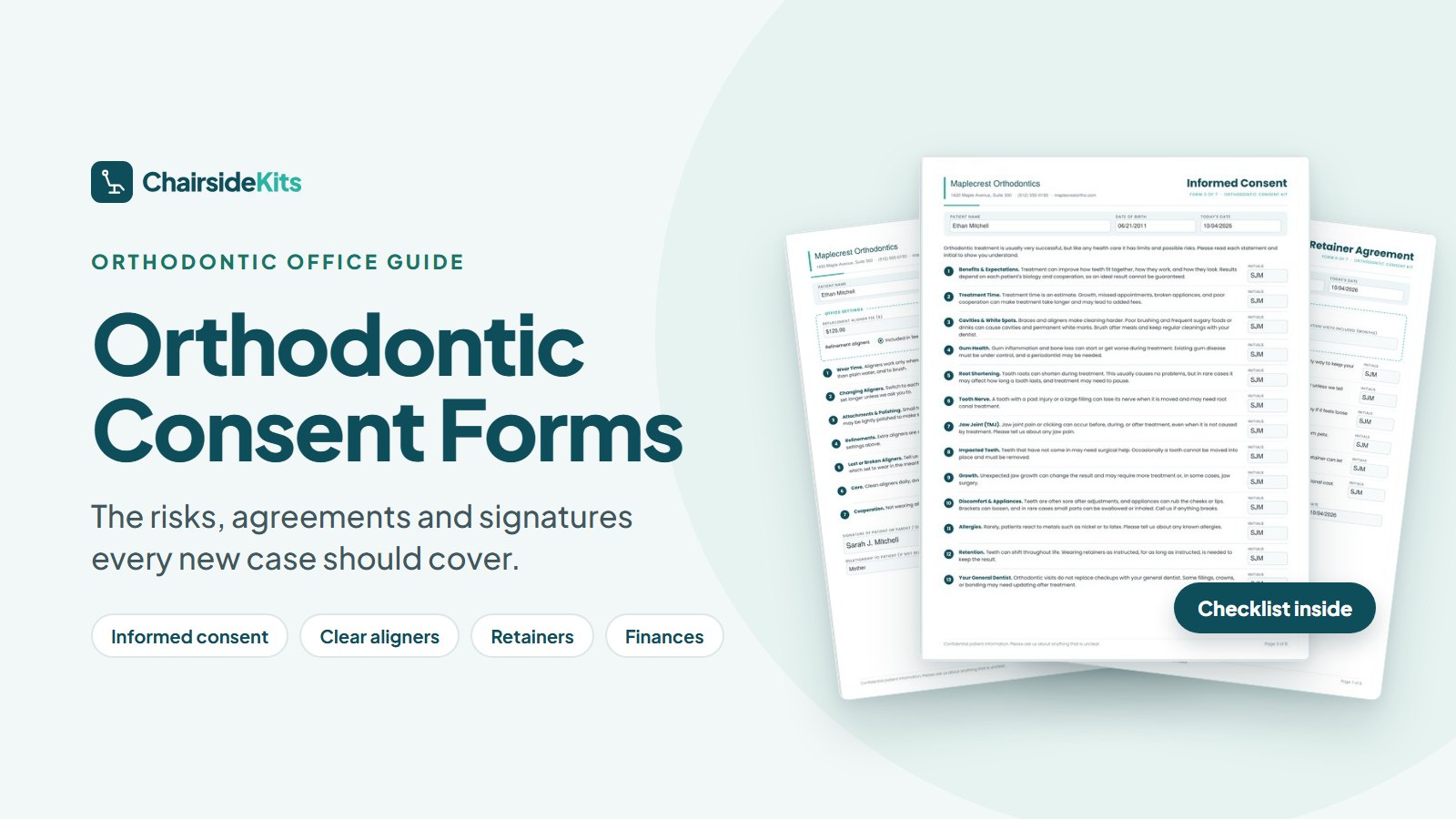
If your packet is missing several items on that list, the Orthodontic Consent Kit has seven forms for a new orthodontic case: an orthodontic questionnaire, a treatment plan summary, a two-page informed consent with 13 initialed risk clauses and room for patient-specific risks, a clear aligner agreement, a retainer agreement, a financial agreement that calculates the balance and monthly payment, and a photo and records consent with separate permissions. Each comes as a fillable PDF and an editable Word file, in English and Spanish, so you can change the wording to match your orthodontist's preferences.
If you also need a medical history for new orthodontic patients, our free dental medical history form is a two-page fillable PDF in English and Spanish.
This article is general information, not legal advice. Consent requirements vary by state, so please review your forms with your attorney and your state dental board requirements before use.