Free Dental Medical History Form (Fillable PDF, English and Spanish)
What a good dental medical history form asks, why each question is there, and how to keep the answers current. Includes a free fillable PDF in English and Spanish.
By ChairsideKits Team · · 8 min read
The patient in chair two is numb and ready for an extraction when the assistant asks, almost as an afterthought, whether they take anything to thin their blood. They do. It was never on the form because the form asked "Are you taking any medications?" and the patient thought of their daily aspirin as a vitamin, not a medication.
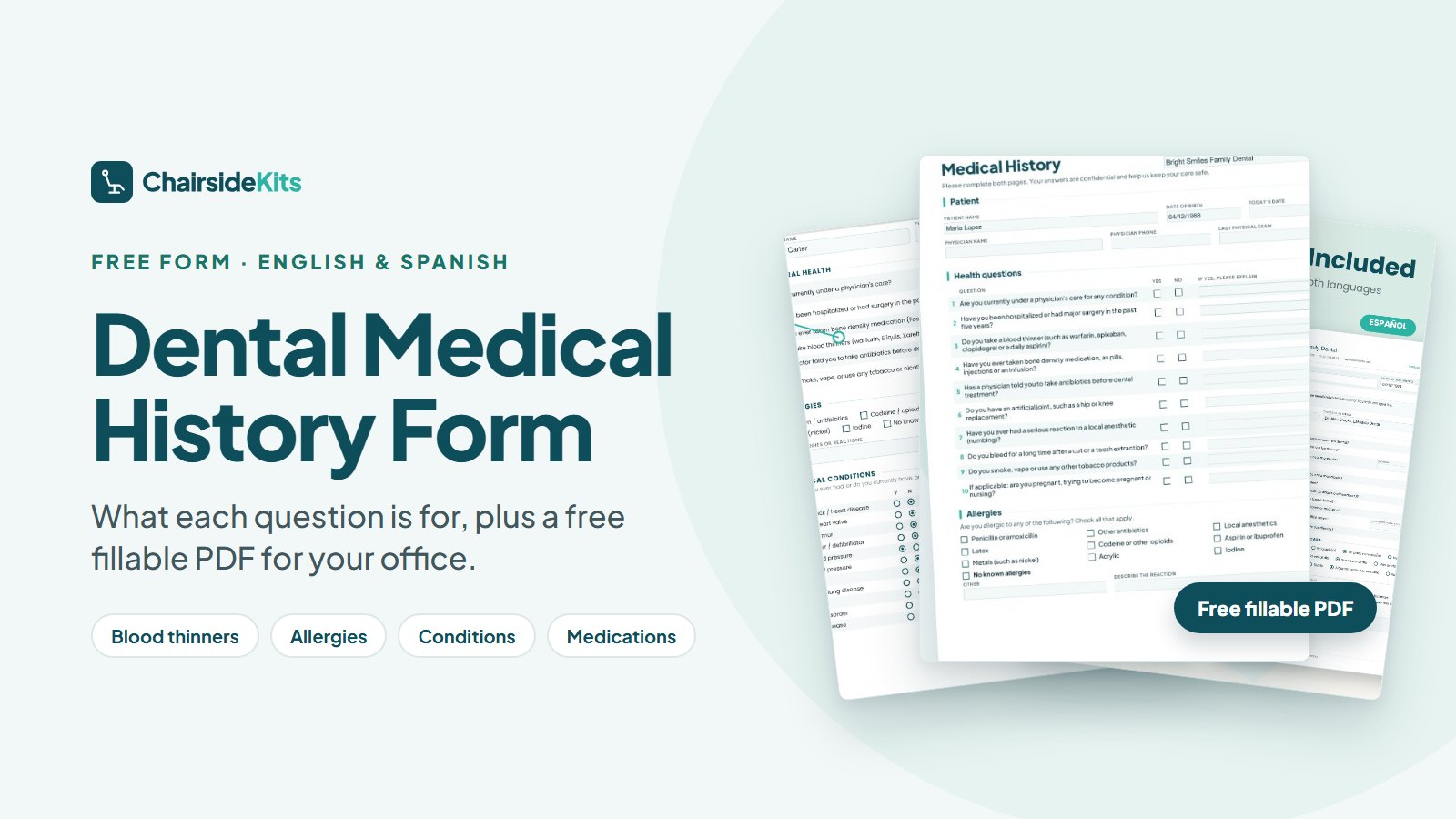
That gap is what a good dental medical history form exists to close. This article walks through the questions that belong on it, the reason each one is there, and how to keep the answers current from visit to visit. If you just want the form, you can download our free dental medical history form: a two-page fillable PDF in English and Spanish with dental-specific health questions, an allergy checklist, a 33-condition checklist, a medication table and an office review log.
What a dental medical history form should cover
A complete dental health history form usually has six parts:
- Patient details and the name of their physician
- Dental-specific health questions (blood thinners, bone density medication, premedication)
- Allergies, as a checklist
- A medical condition checklist
- A medication table
- A signature, a date, and a log where your team records each review
Everything else is optional. Some practices add questions about sleep apnea, recent hospital stays or their own specialty. Those are fine additions, as long as the six basics are there and easy to answer.
The medical history is one form in a larger packet. For the full set (registration, insurance, consent and the rest), see our guide to dental new patient forms.
The questions that matter most in a dental office
A general medical questionnaire from a physician's office asks about everything. A medical history questionnaire for a dental office should ask first about the things that change what happens in the chair. Ask each of these as its own yes or no question, not as part of a long list, because patients skim lists and answer direct questions.
Blood thinners
Ask by name of the category: "Do you take a blood thinner or aspirin every day?" Patients often leave these off a general medication list, as in the scene above. The answer matters for extractions, deep cleanings and anything else that bleeds.
Bone density medication, now or in the past
Some medications for osteoporosis and some cancer treatments are relevant to extractions and implants, even years after the patient stopped taking them. Asking "now or in the past" is the point. A patient who took a weekly pill five years ago will usually answer "no" to "Are you taking bone medication?"
Antibiotic premedication
"Has a physician or dentist ever told you to take antibiotics before dental treatment?" This catches patients with certain heart conditions or joint replacements whose doctor wants them to premedicate. The dentist decides what to do with the answer. The form just has to make sure nobody finds out on the day of the procedure.
Pregnancy and nursing
Asked plainly and only for patients it applies to. It affects X-ray timing, medication choices and how long a patient can comfortably lie back.
Tobacco and vaping
Ask about both. Many patients who vape do not think of themselves as smokers, and it affects gum health and healing.
Recent changes
"Has your health changed since your last visit?" seems obvious, but it is the question that turns a one-time form into something useful over years.
Use a checklist for allergies and conditions
"Do you have any allergies?" with a blank line usually gets a blank line. A checklist gets answers, because it reminds patients of things they would not think to mention.
For allergies, include the ones that come up most in a dental office: penicillin and other antibiotics, local anesthetics, latex, codeine and other pain medications, metals, and an "other" line. Add a column for the reaction. "Penicillin: rash" and "penicillin: throat swelling" lead to very different conversations.
For medical conditions, a grid of checkboxes works better than any open question. Cover heart conditions and artificial heart valves, high or low blood pressure, diabetes, bleeding disorders, joint replacements, asthma and other breathing problems, seizures, stroke, hepatitis and other liver disease, kidney disease, thyroid problems, cancer and radiation or chemotherapy, HIV, osteoporosis, arthritis, and mental health conditions that affect treatment, such as severe anxiety. The free form uses a 33-condition checklist laid out in columns, so a patient can scan it in under a minute and the hygienist can spot a checked box at a glance.
The medication table
A single line labeled "Medications" is the weakest part of most forms. Patients write "see list," "same as before" or nothing at all.
Give them a table with real rows and three columns: name, dose and what it is for. The "what it is for" column helps more than you might expect. A patient may not remember the name of their blood pressure pill, but writing "blood pressure" still tells the dentist what to ask about.
Above the table, say clearly what counts: prescriptions, over-the-counter medicines, vitamins and supplements. Some supplements affect bleeding, and patients almost never list them unless asked.
Keep the answers current with a review log
A medical history collected at the first visit and never touched again gets less accurate every month. Patients start new medications, have surgery, or get a new diagnosis, and they rarely think to tell the dental office.
The fix is small. Add an office review log at the bottom of the form: a few rows with space for the date, "no changes" or "updated," and staff initials. At each visit, someone asks the patient, "Any changes to your health or medications since we last saw you?" and fills in a row. It takes thirty seconds, and it gives you a dated record that the question was asked.
Many practices also ask patients to complete a fresh form on a regular schedule, often once a year, and whenever a patient mentions a major health change. Pick a rule your team will actually follow and write it down.
Spanish versions: same form, same layout
If you see Spanish-speaking patients, give them a Spanish version of the same form rather than translating out loud at the front desk. Health questions are where a misunderstanding matters most, and a patient answers more accurately when they can read the question in their own language at their own pace.
Keep the layout identical between languages. When the checkbox for diabetes sits in the same spot on both versions, an English-speaking hygienist can still read a Spanish form at a glance. The free form follows this rule: the English and Spanish pages match line for line.
Small details that make a big difference
Send it before the visit. A fillable PDF sent with the appointment confirmation lets patients answer at home, with their medication bottles in front of them. Answers are more complete, and nobody is guessing at doses in the waiting room.
Type the practice name once. In a fillable form, the practice name and patient name should carry from page to page. Patients notice when they have to write their name four times, and it makes the form feel longer than it is.
Flag the "yes" answers. Agree on how your team marks a form that needs the dentist's attention: a highlighted box, a note in the chart, a mention in the morning huddle. A checked box nobody reads does not help anyone.
Make the signature line obvious. Put it at the end with a date next to it. An unsigned medical history is something you only notice when you need it.
Store it with the chart, not in a drawer. Completed forms are protected health information. Scan or upload them into the patient's record and handle the paper copies the way your privacy policy says you will.
Checklist: compare your current form
- Physician name and phone number
- Blood thinners asked as a separate question
- Bone density medication, "now or in the past"
- Antibiotic premedication question
- Pregnancy and nursing
- Tobacco and vaping
- Allergy checklist with a column for the reaction
- Condition checklist rather than one open question
- Medication table with name, dose and reason, including supplements
- Signature and date
- Office review log for each visit
- Spanish version with the same layout, if you see Spanish-speaking patients
- Sent to patients before the visit as a fillable PDF
Get the free dental medical history form
If your current form is missing more than two or three items on that list, it is usually faster to replace it than to patch it. Our free dental medical history form PDF covers everything above: 10 dental-specific health questions including blood thinners, bone density medication and antibiotic premedication, an allergy checklist, a 33-condition checklist, a medication table, a signature line and an office review log. It is two fillable pages in English and two in Spanish, and you type your practice name once to fill every page. Enter your email on the page, confirm it, and the download link arrives in your inbox.
If you want the rest of the new patient packet to match, the New Patient Intake Kit includes seven forms (registration, insurance, a two-page medical history, dental history, privacy and communication, consent for treatment, and financial policy) as fillable PDFs and editable Word files, in English and Spanish. The Word version lets you change the wording or add your logo.
This article is general information, not legal or medical advice. Requirements vary by state, so please review your forms with your attorney and your state dental board requirements before use, and leave clinical decisions about any answer to the treating dentist.