Dental New Patient Forms: What to Include (With a Free Checklist)
The forms every new patient should fill out, what each one should ask, and the small details that decide whether check-in takes five minutes or twenty.
By ChairsideKits Team · · 8 min read
A new patient arrives ten minutes early, takes the clipboard, and hands it back twenty minutes later with half the insurance section blank and "see last dentist" written under medications. Your hygienist is waiting, the schedule is already slipping, and someone at the front desk now has to chase details over the phone.
Most of that is fixable, and it starts with the forms themselves. This guide walks through the dental new patient forms almost every practice uses, what each one should actually ask, and the small design choices that decide whether check-in takes five minutes or twenty. There is a short checklist at the end you can compare against your current packet.
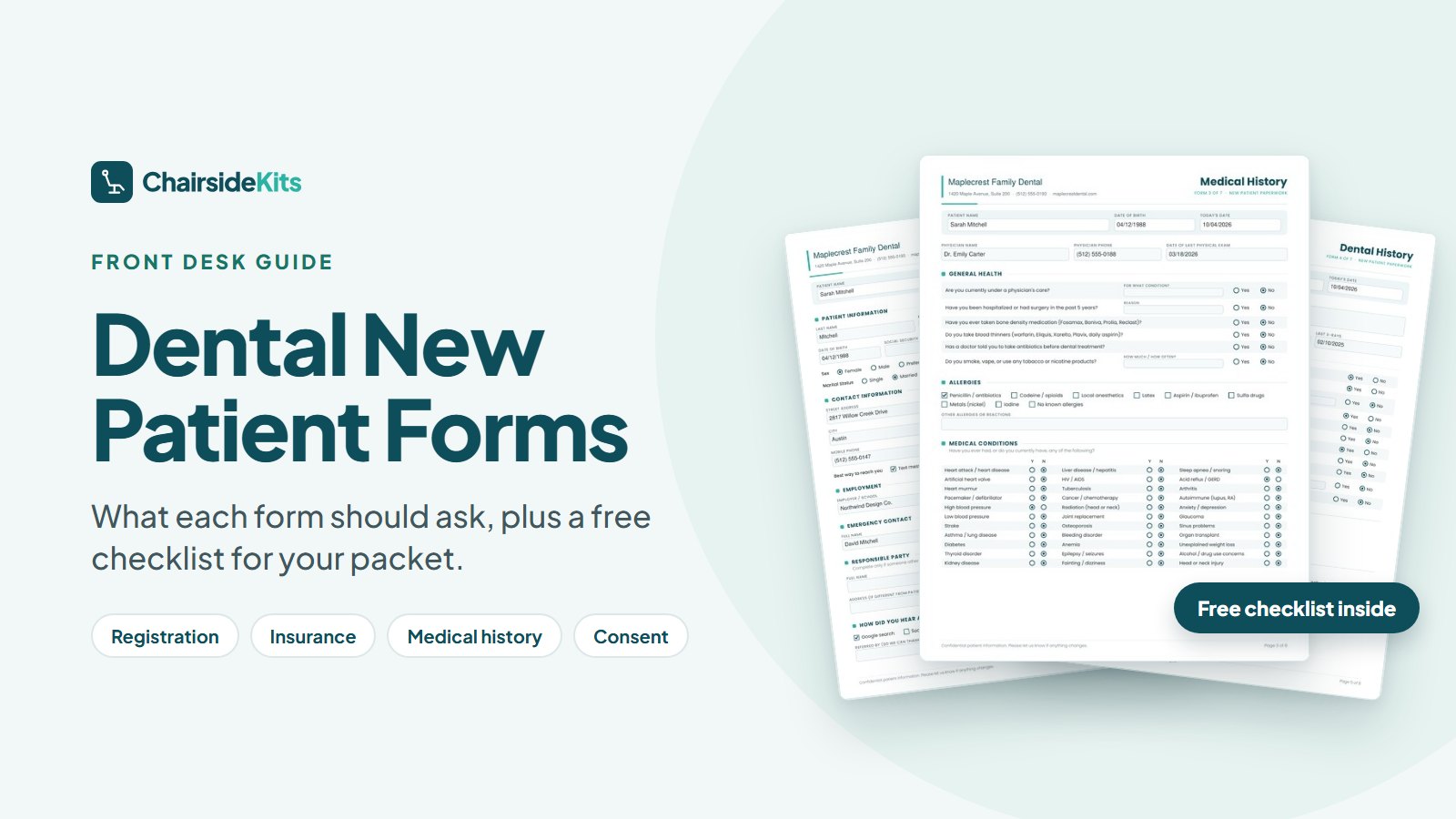
The six forms in a typical new patient packet
Practices name them differently, and some combine two into one page, but a complete new patient packet usually covers six things:
- Patient registration
- Insurance information
- Medical history
- Dental history
- Privacy notice acknowledgment and communication preferences
- Consent for treatment and financial policy
If your packet is missing one of these, the gap usually shows up later as a phone call, a rejected claim, or an awkward conversation about a bill.
1. Patient registration
This is the form everyone already has, and it is the one most likely to be cluttered. Keep it to what your team will actually use:
- Full legal name, preferred name, and date of birth
- Home address, mobile number, and email
- How the patient prefers to be contacted, and whether you may text them
- Emergency contact name and phone number
- For minors: the parent or guardian, and who is financially responsible
- How they heard about you (useful for marketing, and patients rarely mind)
Two details save more time than anything else here. First, ask for the preferred name separately from the legal name, so the hygienist greets "Kate" instead of "Katherine" while the claim still goes out under the legal name. Second, put the texting question on this page, not buried in a consent form at the back. If your reminders go out by text, you need that answer on day one.
2. Insurance information
Incomplete insurance details are the most common reason a front desk spends the first visit on the phone. Ask for:
- Subscriber name and date of birth (often not the patient)
- Relationship of the patient to the subscriber
- Insurance company name and phone number from the back of the card
- Member ID and group number
- Employer name
- Secondary insurance, if any, with the same details
Then add one line that does more than all of the above: "Please bring your insurance card, or email a photo of the front and back before your visit." A photo of the card answers most of these questions correctly, and it lets your team verify benefits a day ahead instead of while the patient sits in the waiting room.
3. Medical history
This is the form that matters most clinically, and the one patients are most tempted to rush. A good dental medical history form is specific. "Any medical conditions?" with a blank line gets you a blank line. A checklist gets you answers.
At a minimum, ask about:
- Current medications, including over-the-counter drugs and supplements, with space to list them
- Blood thinners, asked as their own question, because patients often do not think of them as "medications" worth mentioning
- Bone density medications, including past use, since some of these matter for extractions and implants
- Antibiotic premedication: whether a physician has ever told them to take antibiotics before dental work
- Allergies, with checkboxes for the ones that come up most in a dental office: penicillin and other antibiotics, local anesthetics, latex, and metals
- A condition checklist: heart conditions, high blood pressure, diabetes, bleeding disorders, joint replacements, asthma, seizures, hepatitis, kidney or liver disease, cancer treatment, and so on
- Pregnancy or nursing, for patients this applies to
- Tobacco and vaping
Two pages is about right. Shorter usually means something important was left out. Much longer, and patients start skimming.
The part many practices forget is the review. A medical history collected once and never updated becomes less accurate every visit. Add a small "reviewed with patient" section at the bottom of page two, with room for a date and staff initials, so the team can confirm at each visit that nothing has changed. That habit catches the new prescription the patient would never have mentioned on their own.
4. Dental history
The dental history form gives the dentist context before they walk in:
- Date of the last dental visit and the last X-rays
- The reason for today's visit, in the patient's own words
- Any pain, sensitivity, or areas of concern
- Past treatment: orthodontics, implants, gum treatment, extractions
- Habits such as grinding or clenching
- Dental anxiety, and anything that makes visits easier for them
That last question is worth keeping. A patient who checks "I get nervous at the dentist" is telling you how to schedule them, how to talk to them, and how much time to allow. It costs you one line.
5. Privacy notice acknowledgment and communication preferences
Under HIPAA, dental offices generally give new patients their Notice of Privacy Practices and make a good-faith effort to get a written acknowledgment that the patient received it. A short acknowledgment form handles this. It does not need to repeat the whole notice; it confirms the patient was offered it.
This is also the natural place to record how the patient is willing to be contacted about appointments and results: text, email, voicemail at home, voicemail at work. Patients care about this more than you might expect, and a clear record protects your team when a message goes to the wrong phone.
6. Consent for treatment and financial policy
A general consent for treatment confirms the patient agrees to examination, X-rays, and routine care. Specific procedures such as extractions, implants, or orthodontics usually get their own consent forms later, when that treatment is planned. Requirements vary from state to state, so check yours.
The financial policy is where you prevent most billing disputes before they start. Say plainly:
- When payment is due (usually at the time of service)
- That insurance estimates are estimates, and the patient is responsible for what insurance does not pay
- Which payment methods you accept, and whether payment plans are available
- Your missed appointment or late cancellation policy
Have the patient sign and date it. When a balance question comes up three months later, a signed, plainly worded policy turns a debate into a quick conversation.
Small details that make a big difference
The content of the forms is half the job. How you hand them out is the other half.
Send the forms before the visit. A fillable PDF or link sent with the appointment confirmation lets patients answer at home, with their medication bottles and insurance card in front of them. The answers are more complete and the waiting room moves faster.
Ask each question once. If the registration form asks for the date of birth, the medical history should not ask again. Repeated questions make forms feel longer than they are, and patients start skipping. A fillable PDF that carries the name and date of birth from page to page solves this neatly.
Offer the forms in Spanish. If you see Spanish-speaking patients, a Spanish version of the same forms gets you more accurate medical histories than a translated conversation at the front desk. Keep the layout identical between languages so your team can read either version at a glance.
Leave room to write. Medication lists need real space. Give it three short lines and you will almost always get "see list" or a blank.
Make signatures and dates obvious. Put signature lines where they are hard to miss, and include a date next to every one. An unsigned consent is a problem you only discover when you need it.
A quick checklist for your new patient packet
Use this to review the forms you have now:
- Registration asks for a preferred name and permission to text
- Emergency contact and, for minors, guardian and responsible party
- Insurance section covers the subscriber, secondary insurance, and asks for a card photo
- Medical history has a medication list, blood thinners, bone density medications, and premedication as separate questions
- Allergy checklist includes antibiotics, local anesthetics, and latex
- Condition checklist rather than a single open question
- A "reviewed with patient" log on the medical history
- Dental history includes the reason for the visit and dental anxiety
- Privacy notice acknowledgment and communication preferences
- General consent for treatment
- Financial policy covering payment timing, insurance estimates, and missed appointments
- Spanish versions, if you see Spanish-speaking patients
- Forms sent before the visit, not only on a clipboard
Start with the medical history
If you only fix one form this month, make it the medical history. It is the one where missing information matters most, and the one patients are most likely to rush.
You can download our free fillable dental medical history form. It is two pages, in English and Spanish, with the dental-specific questions above, an allergy and condition checklist, a medication table, and a review log. Type your practice name once and it fills every page.
If you would rather replace the whole packet at once, the New Patient Intake Kit includes all seven forms (registration, insurance, medical history, dental history, privacy and communication, consent for treatment, and financial policy) as fillable PDFs and editable Word files, in English and Spanish.
This article is general information, not legal advice. Forms and consent requirements vary by state, so please review your forms with your attorney and your state dental board requirements before use.